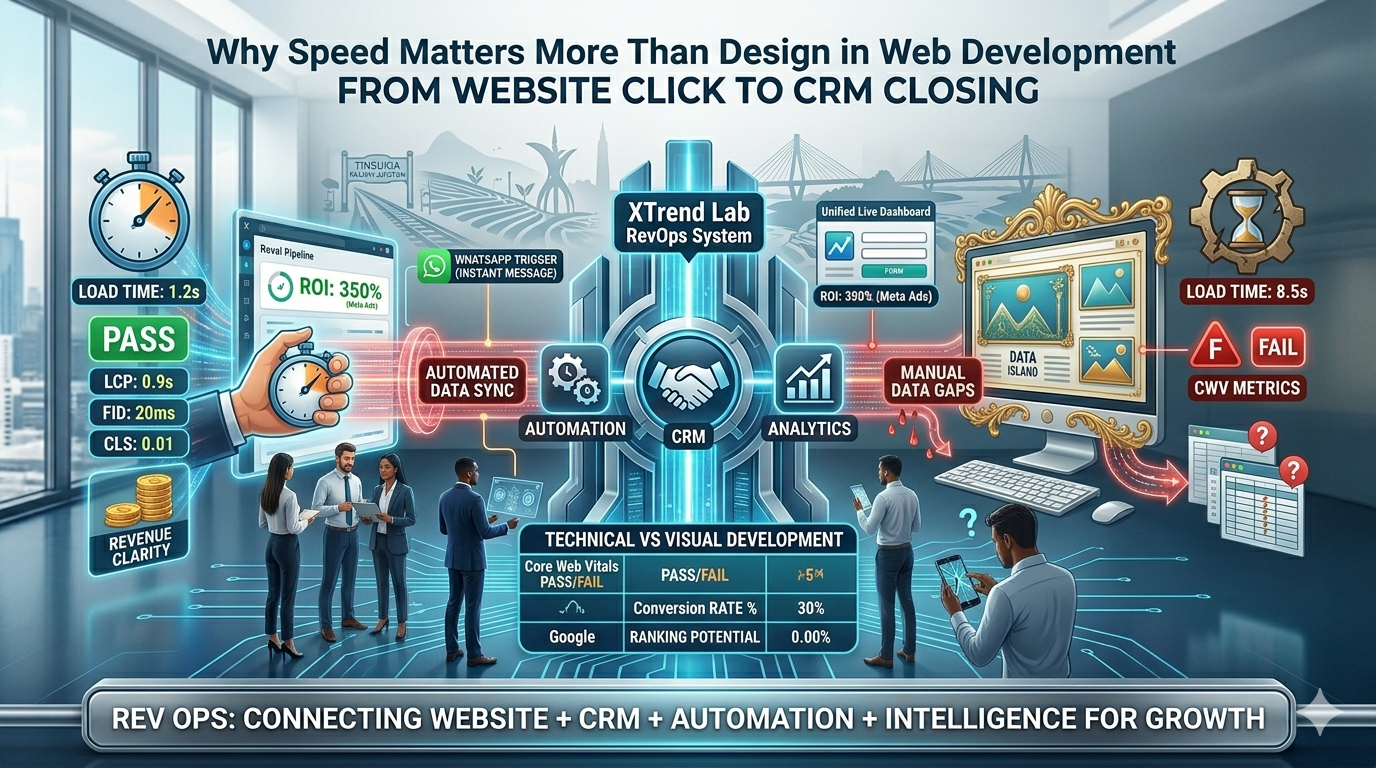
In the world of modern business, many owners prioritize the visual “brochure” look of their website above all else. However, in 2026, a beautiful website that loads slowly is effectively invisible. In the hierarchy of high-performance web development, speed is the foundation of revenue, while design is merely the aesthetic layer on top.
Website speed is a critical ranking factor because it directly impacts Core Web Vitals and user retention. While design influences first impressions, speed determines whether a visitor stays long enough to convert. A fast-loading site is essential for technical SEO, lower bounce rates, and successful RevOps integration.
1. Speed is the First Impression
Before a visitor can appreciate your custom graphics or unique branding, they have to wait for the page to load.
- The 3-Second Rule: Research shows that most visitors will abandon a mobile site if it takes more than 3 seconds to load.
- Invisible Design: If your site is slow, your “beautiful design” never even gets seen, resulting in lost traffic and wasted ad spend.
- Trust and Professionalism: A fast, snappy website signals technical competence and reliability, whereas a slow site creates immediate frustration and distrust.
2. Google Ranks Performance, Not Aesthetics
Search engines like Google do not have eyes; they have algorithms that measure Core Web Vitals.
- Ranking Factor: Page speed is a confirmed ranking signal. Slow sites are penalized and pushed down in search results.
- Mobile-First Indexing: Google primarily uses the mobile version of your content for indexing and ranking, making mobile-first speed optimization non-negotiable.
- SEO-Friendly Foundation: A fast site allows Google’s crawlers to index your pages more efficiently, improving your overall visibility.
3. Speed Drives Conversions (The RevOps Angle)
In a connected revenue system, every second of delay directly reduces your conversion rate.
- Friction-Free Lead Capture: High-speed sites ensure that forms and WhatsApp triggers load instantly, capturing leads while their intent is highest.
- Lower Bounce Rates: Faster pages keep users engaged longer, increasing the likelihood that they will interact with your CRM-connected capture tools.
- Better Ad ROI: When you send paid traffic to a slow landing page, your Cost Per Lead (CPL) skyrockets because people bounce before the tracking pixels even fire.
Technical vs. Visual Development
At XTrend Lab, we focus on “Revenue Systems” rather than just “Brochure Sites.”
| Feature | Design-First Approach | Speed-First (RevOps) Approach |
| Focus | Visual flair and heavy animations | Fast loading and clear conversion paths |
| User Experience | Subjective and “pretty” | Objective, fast, and stable |
| SEO Impact | Minimal or negative (heavy assets) | High (optimized Core Web Vitals) |
| Conversion | Passive and brochure-like | Active and system-driven |
FAQs
Why is website speed important for SEO?
Website speed is a core part of Google’s ranking algorithm via Core Web Vitals. Faster sites provide a better user experience, leading to lower bounce rates and higher rankings in search results.
Does a fast website improve conversion rates?
Yes. Faster websites reduce user friction, allowing leads to book calls or send WhatsApp messages instantly. Even a one-second improvement in load time can significantly increase conversion percentages.
How can I check my website speed?
You can use tools like Google PageSpeed Insights to measure your site’s performance. At XTrend Lab, we include a full speed and tracking audit in our free 30-minute consultation.
Stop Building Brochures. Build Fast Systems.
A beautiful site is a vanity metric; a fast site is a business asset. At XTrend Lab, we specialize in website speed optimization and technical SEO to ensure your site isn’t just “pretty”—it’s profitable.
Book a free 30-minute audit today. We’ll show you exactly how your current speed is impacting your revenue and how to fix it.
XTrend Lab Strategy Team
We are a collective of data engineers, strategists, and digital architects. We write about what works in the real world, based on our experience building systems for growing enterprises.