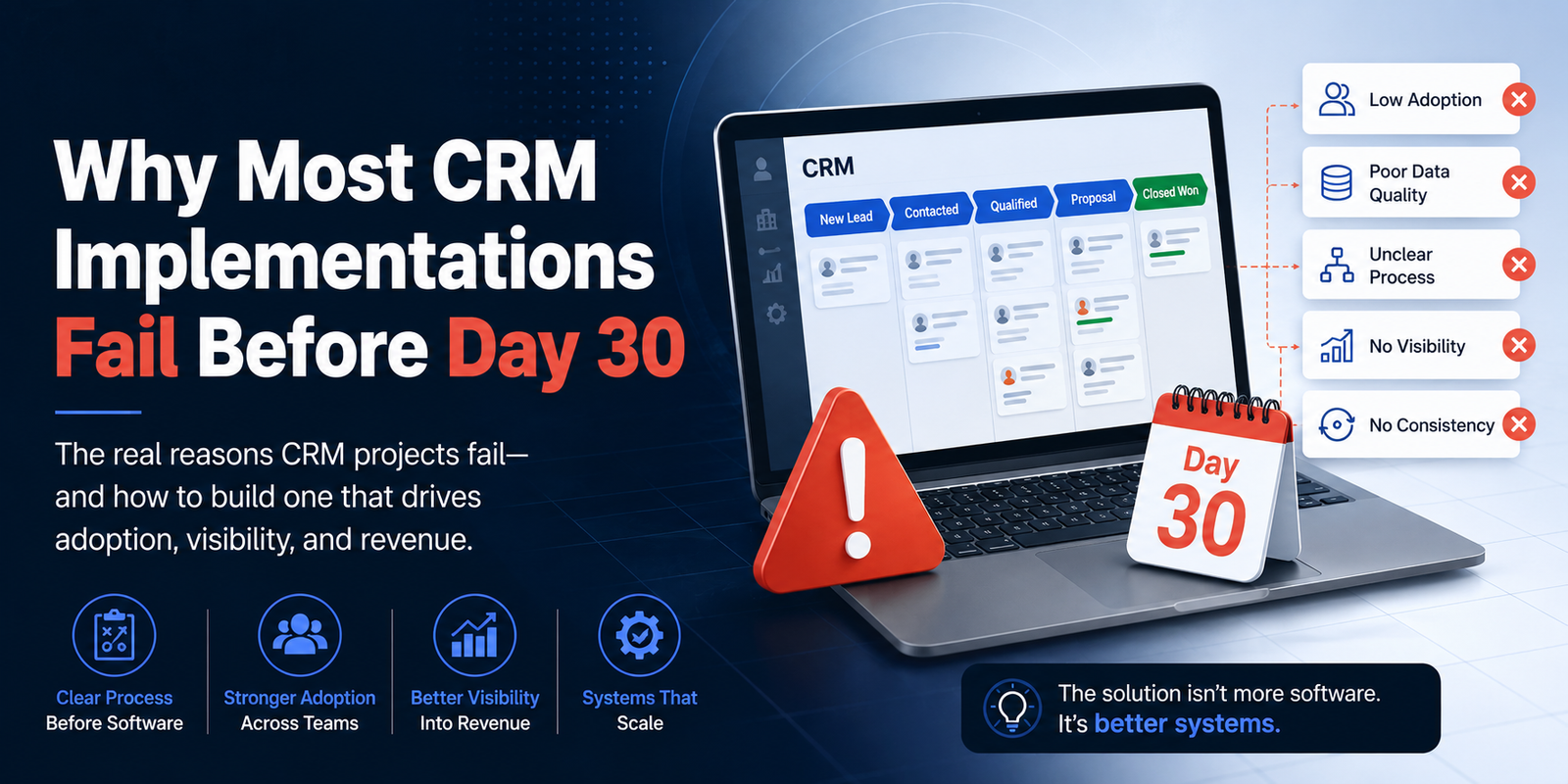
A CRM is one of the most important systems a growing business can implement. It centralizes customer information, creates visibility across the sales process, and provides the foundation for automation, forecasting, and reporting.
Yet despite its importance, most CRM projects fail surprisingly quickly.
The failure rarely happens because of the software itself. Modern CRM platforms such as HubSpot, Zoho, Salesforce, and Pipedrive are powerful, mature tools capable of supporting businesses of every size. The real problem is that companies often treat CRM implementation as a technology project when it is fundamentally an operations project.
A CRM cannot fix a broken sales process. It cannot compensate for poor accountability, inconsistent follow-up, or unclear ownership. What it does exceptionally well is expose those problems.
Businesses that understand this distinction build systems that scale. Businesses that don’t often find themselves abandoning their CRM within weeks of implementation.
The Problem Starts Before the CRM Is Installed
Many organizations approach CRM implementation with the assumption that software will create structure.
In reality, structure must exist before software can be effective.
Before selecting a CRM platform, businesses should be able to clearly explain how a lead moves from first inquiry to closed revenue. They should understand who owns each stage of the process, what information must be captured, and how progress is measured.
Unfortunately, this level of clarity is often missing.
Ask different employees how a lead moves through the business and you’ll frequently receive different answers. Sales representatives follow their own methods. Managers track different metrics. Customer information exists in emails, WhatsApp conversations, spreadsheets, and personal notes.
When a CRM is introduced into this environment, the underlying confusion doesn’t disappear. It simply becomes more visible.
Most CRM Failures Are Actually Process Failures
One of the biggest misconceptions about CRM implementation is that success depends primarily on software features.
In practice, adoption depends far more on operational design.
Businesses often spend weeks comparing CRM platforms while spending very little time defining how the system will actually be used. Teams debate automation capabilities, reporting dashboards, and integration options before agreeing on basic sales workflows.
The result is predictable.
The CRM launches successfully, but employees continue operating exactly as they did before. Information remains fragmented. Opportunities are tracked inconsistently. Reports become unreliable. Within a few weeks, trust in the system begins to decline.
When people stop trusting the data, they stop using the platform.
At that point, the CRM becomes little more than an expensive contact database.
Why Teams Continue Working Outside the System
One of the earliest warning signs of CRM failure is the continued use of parallel systems.
Sales teams continue relying on WhatsApp conversations. Customer information remains scattered across spreadsheets. Follow-up reminders are stored in personal notebooks or calendars. Important notes never make their way into the CRM.
This creates a dangerous situation where the business operates in two realities at once.
The first reality exists inside the CRM. The second exists inside the habits of individual employees.
Management reviews reports based on CRM data while employees continue managing opportunities elsewhere. Over time, the gap between reality and reporting becomes significant.
Eventually, leadership loses confidence in the numbers. Once that happens, adoption becomes extremely difficult to recover.
The goal of CRM implementation is not simply to collect information. The goal is to create a single source of truth for the business.
Pipeline Stages Are Often Poorly Designed
Many CRM implementations fail because pipeline stages are too vague.
Businesses frequently use labels such as:
- New Lead
- Qualified
- Proposal
- Closed
At first glance, these stages appear logical. The problem is that they mean different things to different people.
What qualifies a lead?
When does a prospect move from one stage to another?
What criteria must be met before a proposal is considered active?
Without clear definitions, consistency disappears.
Effective CRM systems use stages based on measurable events rather than interpretations. For example, stages such as “Inquiry Received,” “First Contact Completed,” “Requirements Confirmed,” “Proposal Sent,” and “Negotiation Active” provide much greater clarity because they describe specific actions rather than subjective opinions.
When everyone uses the same language, reporting becomes significantly more reliable.
The Hidden Cost of Poor CRM Adoption
Businesses often underestimate the consequences of low adoption.
The immediate impact is obvious. Reports become inaccurate, opportunities get lost, and management loses visibility.
The long-term consequences are even more damaging.
Poor adoption makes forecasting unreliable. Revenue becomes difficult to predict. Marketing teams struggle to understand which channels generate results. Sales managers cannot identify bottlenecks. Leadership loses the ability to make informed decisions.
The CRM stops functioning as an operational system and becomes little more than administrative overhead.
Ironically, businesses often blame the software at this stage. In reality, the platform is simply reflecting deeper organizational problems that were never addressed.
Why Automation Cannot Save a Broken Process
Many companies attempt to solve adoption problems through automation.
This approach rarely works.
Automation amplifies processes. It does not improve them.
If lead assignment is inconsistent, automation distributes inconsistency faster. If customer data is incomplete, automated reports become inaccurate more efficiently. If follow-up processes are poorly defined, automation simply creates more notifications without solving the underlying problem.
Businesses often assume AI and automation will compensate for operational weaknesses. In reality, they magnify them.
The strongest automation strategies are built on stable, repeatable workflows. Without those workflows, automation becomes expensive complexity.
The First 30 Days Determine Everything
The first month after implementation often determines whether a CRM becomes a strategic asset or an abandoned project.
During this period, businesses establish habits, define expectations, and build trust in the system. If adoption is weak during the first few weeks, recovery becomes significantly more difficult later.
Successful implementations focus on four priorities during the first month:
Week One: Define the Process
Before importing data or configuring automation, document the sales process. Establish ownership, responsibilities, and clear stage definitions.
Week Two: Clean and Organize Data
Remove duplicate contacts, standardize fields, and ensure information is accurate before migration.
Week Three: Train Around Workflows
Training should focus on daily activities rather than software features. Employees need to understand how the CRM supports their work, not simply where buttons are located.
Week Four: Monitor Adoption
Review usage patterns, identify gaps, and address issues quickly. Small corrections early prevent larger problems later.
The Best CRM Is the One People Actually Use
Businesses spend enormous amounts of time comparing CRM platforms.
HubSpot versus Zoho.
Salesforce versus Pipedrive.
Features versus pricing.
Integrations versus customization.
While these comparisons have value, they often distract from a more important reality.
The best CRM is the one your team consistently uses.
A simple system with strong adoption will outperform a sophisticated system that employees avoid. Consistency creates visibility. Visibility creates intelligence. Intelligence supports better decisions.
Technology matters, but behavior matters more.
The businesses that achieve the greatest success with CRM systems are not necessarily those with the most advanced platforms. They are the ones with the clearest processes, strongest accountability, and highest levels of adoption.
Frequently Asked Questions
Why do CRM implementations fail?
Most CRM implementations fail because businesses focus on software configuration instead of operational design. Poor process definition, low adoption, unclear ownership, and inconsistent data are the most common causes of failure.
How long does CRM implementation typically take?
For most small and medium-sized businesses, implementation can be completed within two to four weeks. Long-term success depends less on setup time and more on adoption and process design.
Which CRM is best for small businesses in India?
HubSpot, Zoho CRM, Pipedrive, and Salesforce are all strong options. The best choice depends on business requirements, budget, team size, and operational complexity.
Should businesses automate immediately after CRM implementation?
Automation should only be introduced after workflows are stable and adoption is consistent. Automating poorly defined processes often creates additional problems.
What is the most important factor in CRM success?
User adoption. Even the most advanced CRM platform delivers little value if employees do not use it consistently and accurately.
Build Systems, Not Just CRMs
A CRM should provide visibility, accountability, and operational clarity. It should help teams understand where opportunities exist, where bottlenecks occur, and how revenue moves through the business.
At XTrend Lab, we help businesses design and implement revenue systems that go beyond software. From CRM setup and process design to automation and reporting, we build operational foundations that support long-term growth.
If you’re planning a CRM implementation or struggling with adoption, start with the system before the software.
Book a strategy call and build a CRM that works beyond the first 30 days.
XTrend Lab Strategy Team
We are a collective of data engineers, strategists, and digital architects. We write about what works in the real world, based on our experience building systems for growing enterprises.