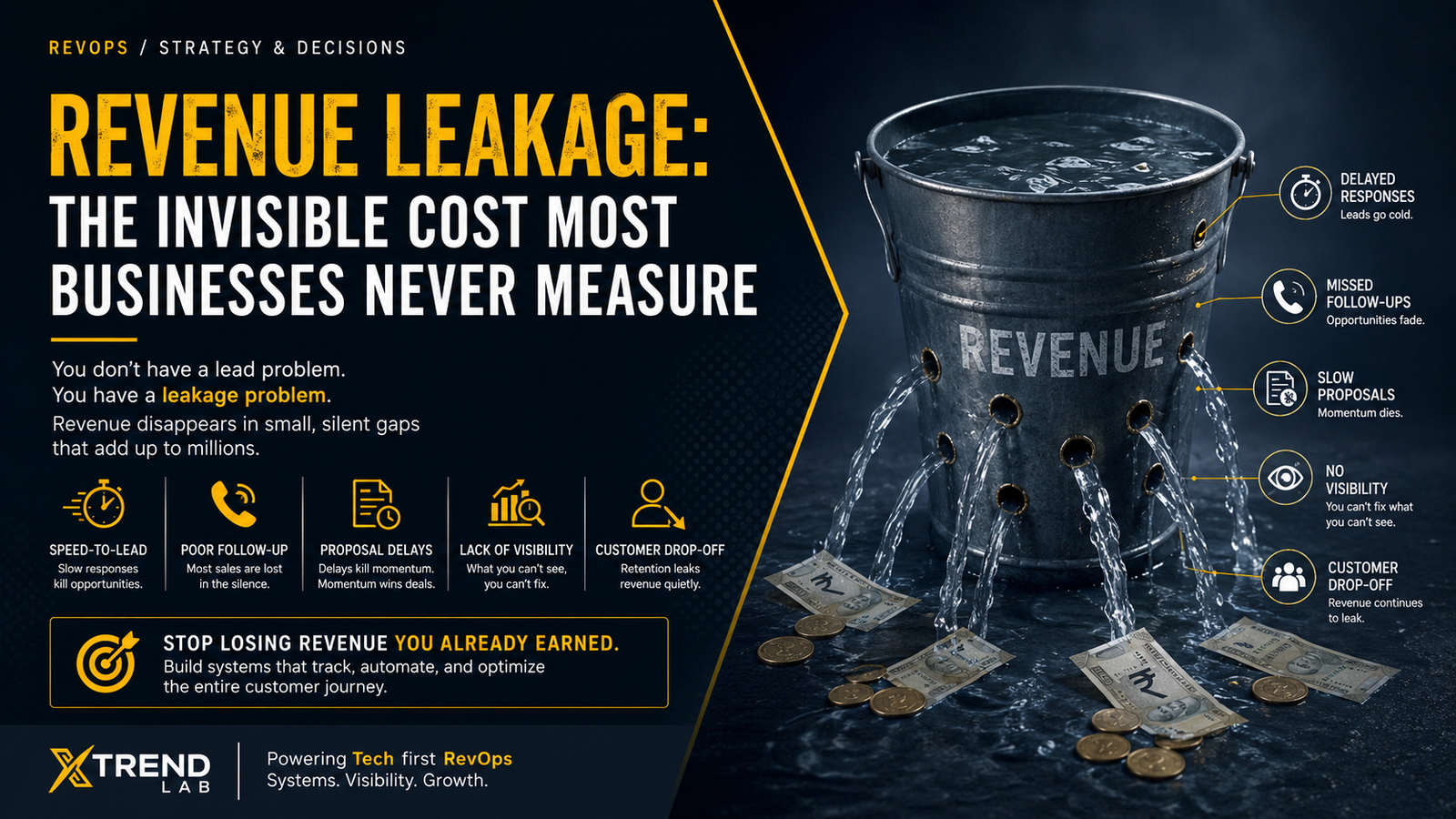
Most businesses don’t have a lead generation problem. They have a leakage problem. Revenue doesn’t disappear because marketing stopped working, it disappears because leads fall through cracks nobody notices. Follow-ups are delayed, proposals sit unanswered, sales conversations vanish, and existing customers quietly leave.
Everyone sees the front door. Very few businesses look at the holes in the walls. Revenue leakage is expensive because it happens silently. Unlike losing a customer publicly, leakage happens one missed call, one forgotten lead, and one delayed proposal at a time. By the end of the year, thousands or even millions disappear without anyone knowing why.
More Leads Won’t Fix Broken Operations
When growth slows, most companies react the same way: they increase ad spend, hire another salesperson, launch new campaigns, and spend more money. But adding more leads into a broken system is like pouring more water into a leaking bucket. Volume doesn’t solve inefficiency, it amplifies it.
The problem usually isn’t at the top of the funnel. It’s what happens after a lead enters the system.
Where Revenue Leakage Happens
Most businesses leak revenue in five places.
Speed-To-Lead
Response time matters more than most people realize. A lead contacted within five minutes behaves differently from one contacted after six hours. Interest fades, competitors respond faster, and conversations disappear. Many businesses measure monthly revenue, but very few measure lead response time, even though response speed is one of the strongest predictors of conversion.
Poor Follow-Up Discipline
Most sales aren’t lost after the first call. They’re lost because nobody called again. People get busy, messages are forgotten, reminders never happen, weeks pass, and potential customers move on. Revenue leakage often looks like silence, not rejection; businesses think customers said no, when in reality nobody followed up.
Proposal Bottlenecks
Sales teams work hard to generate opportunities, then proposals take three days to prepare, approvals take another week, and pricing discussions get delayed. Momentum disappears. Customers rarely wait, speed creates confidence, delays create doubt, and a slow proposal process quietly kills revenue.
Lack of Visibility
Most managers don’t know which deals are stuck, which salesperson responds fastest, which channels generate quality leads, why customers leave, or how long sales cycles actually take. Without visibility, decisions become guesses, and guesswork is expensive.
Customer Drop-Off
Revenue leakage doesn’t stop after acquisition. Customers disappear too, through poor onboarding, slow support, inconsistent communication, missed renewals, and a lack of upselling. Most businesses obsess over acquiring customers and completely ignore retention, even though replacing customers is always more expensive than keeping them.
Leakage Compounds Over Time
Small inefficiencies become massive problems. Imagine 100 leads every month: 10% lost because nobody responded quickly, another 10% lost because follow-ups never happened, another 5% lost due to delayed proposals, and another 10% lost after onboarding. Individually, these numbers don’t seem alarming. Together, they destroy growth. Businesses often think market conditions are responsible. In reality, operations are.
Why Marketing Metrics Hide Revenue Leakage
Marketing dashboards usually celebrate impressions, reach, clicks, followers, and traffic. These metrics look impressive, but none of them answer the real question: where did the money disappear? Businesses celebrate generating 500 leads, but nobody asks what happened to lead number 237, or 389, or 471. Revenue leakage lives in the gap between acquisition and conversion, and vanity metrics rarely expose that gap.
Revenue Leakage Is an Operations Problem
Marketing teams blame sales. Sales blames marketing. Operations blames both. Meanwhile, customers don’t care, they only experience one company. Revenue leakage happens when departments operate independently: marketing generates leads, sales manages conversations, operations delivers service, and finance tracks money. Each team optimizes its own objectives, and nobody optimizes revenue. That’s where Revenue Operations becomes important.
RevOps Creates Visibility
Revenue Operations aligns systems, people, and processes. Instead of disconnected teams, RevOps creates one shared view of growth, covering pipeline health, response times, conversion rates, revenue attribution, customer lifetime value, and bottlenecks. Without visibility, businesses react. With visibility, businesses optimize.
Leading Indicators Matter More Than Revenue
Revenue is a lagging indicator. By the time revenue drops, the damage has already happened. Leading indicators reveal problems earlier. Track speed-to-lead (how quickly are inquiries contacted), follow-up frequency (how often are prospects engaged), proposal turnaround time (how long does it take to send quotations), opportunity age (how long have deals been stuck), and customer churn (how many customers disappear monthly). These metrics predict future revenue. Revenue itself only tells you what already happened.
Most Businesses Have Data But No Intelligence
CRMs, Google Analytics, Facebook Ads, Excel sheets, WhatsApp chats, and invoices, businesses collect enormous amounts of information. But information isn’t intelligence. Data becomes valuable only when connected. Disconnected systems create disconnected decisions, and leaders end up making choices based on intuition. Intuition works until complexity increases. Then systems become necessary.
Revenue Leakage Creates Hidden Costs
Lost deals aren’t the only problem. Leakage also creates higher acquisition costs (more marketing spend becomes necessary), team burnout (employees work harder to compensate), forecasting errors (growth becomes unpredictable), cash flow problems (delayed conversions affect operations), and customer frustration (slow processes damage trust). These costs rarely appear in reports, but they compound over time.
Fixing Revenue Leakage Starts With Process
Software alone won’t solve leakage. Neither will AI. First, businesses need visibility. Questions to ask: where are leads slowing down, where are opportunities getting stuck, which teams create delays, what information is missing, and which processes rely entirely on people remembering things? These questions uncover operational debt. Fix the process, then automate. Never reverse the order.
Systems Compound Revenue
Campaigns create spikes. Systems create compounding. The businesses that grow consistently aren’t always the ones spending the most on marketing, they’re the ones losing the least revenue. Growth isn’t only about adding more; it’s also about protecting what already exists. Every hour saved, every follow-up automated, every bottleneck removed, and every delayed proposal fixed, these improvements compound. Eventually, operations become a competitive advantage.
Frequently Asked Questions
What is revenue leakage?
Revenue leakage refers to money lost because of operational inefficiencies such as delayed responses, poor follow-ups, broken processes, customer churn, or lack of visibility.
Why do businesses experience revenue leakage?
Most businesses operate with disconnected teams and systems. Lack of accountability and visibility causes opportunities to fall through unnoticed.
Can CRM software solve revenue leakage?
CRM software helps create visibility, but software alone cannot solve process problems. Businesses need clearly defined workflows before implementing technology.
How does Revenue Operations reduce revenue leakage?
Revenue Operations aligns marketing, sales, and operations under one system. This improves response times, tracking, forecasting, and accountability.
What metrics reveal revenue leakage?
Leading indicators such as speed-to-lead, follow-up frequency, proposal turnaround time, churn rate, and opportunity age often reveal leakage before revenue declines.
Stop Losing Revenue You Already Earned
Most businesses don’t need more leads. They need better systems. At XTrend Lab, we build Revenue Operations frameworks that help businesses track, automate, and optimize the entire customer journey, because growth isn’t just about generating demand, it’s about preventing revenue from leaking after demand arrives.
Start a conversation and build systems that protect revenue.
XTrend Lab Strategy Team
We are a collective of data engineers, strategists, and digital architects. We write about what works in the real world, based on our experience building systems for growing enterprises.