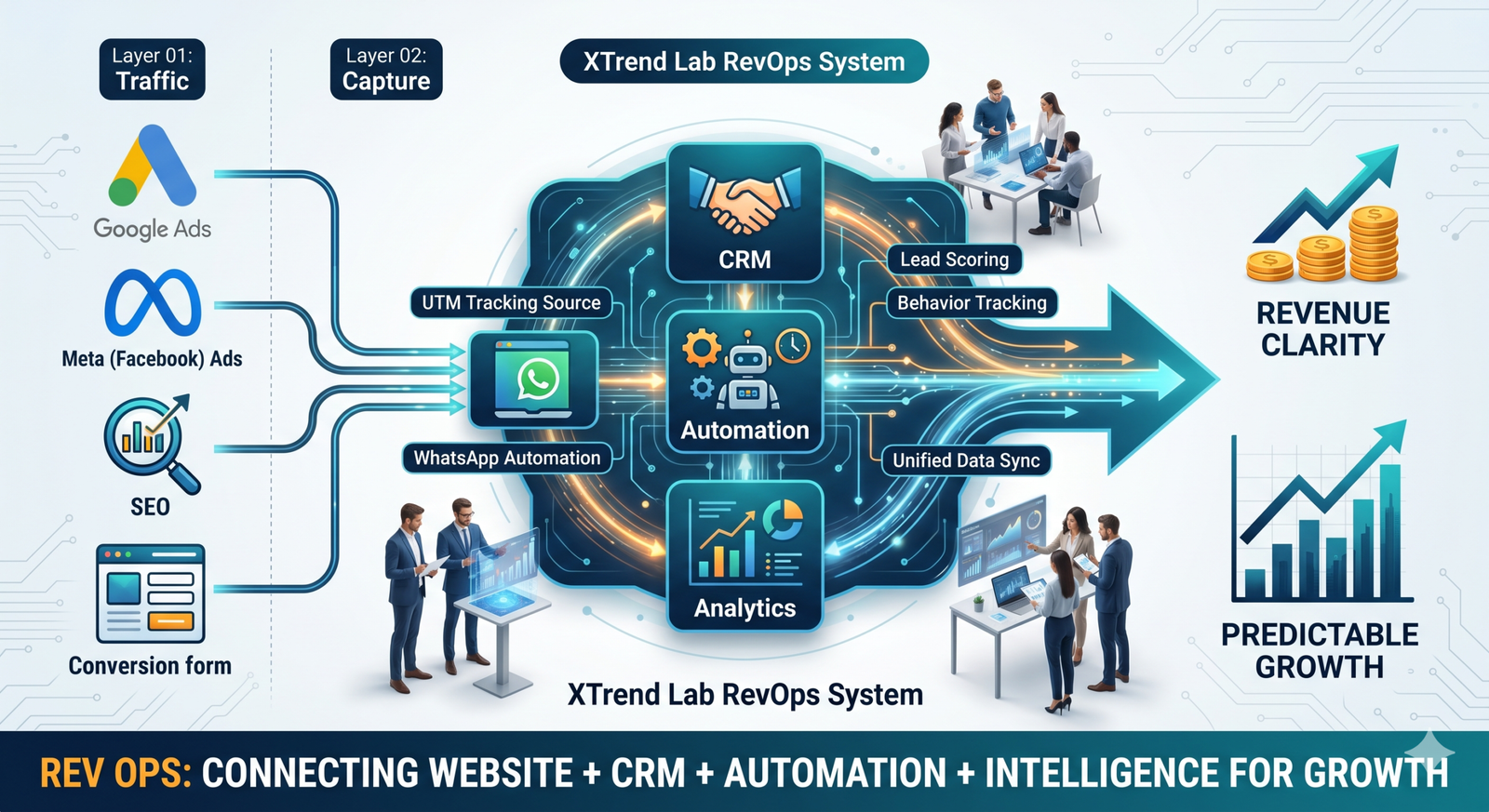
For most business owners, the “lead gap” is a constant source of frustration. A visitor lands on your site, fills out a form, and then… nothing happens until a human manually checks an email or a spreadsheet. By then, the lead has often gone cold.
The solution isn’t more manual work; it’s a connected revenue system that automates the journey from the first click to the final sale.
To track leads automatically, you must integrate a website tracking layer with a CRM through a structured UTM framework. This ensures that every lead is captured with its original source data, instantly routed to sales, and recorded in a live dashboard for total revenue visibility.
The 5-Step Automated Tracking Flow
At XTrend Lab, founded by Prayag Dev Adhikari, we implement a specific architecture to ensure no lead is ever “invisible”.
1. The Source Tag (Traffic Layer)
Automation starts before the visitor even hits your site. Every ad, social post, or email link must be tagged with UTM parameters (utm_source, utm_medium, utm_campaign). This allows the system to identify exactly which marketing effort drove the visit.
2. The Arrival (Capture Layer)
When the visitor lands, a custom website build with an integrated tracking layer captures these UTMs. Even if they browse multiple pages, the system records their behavior, session data, and intent.
3. The Sync (CRM Layer)
This is where most businesses fail. Instead of a simple email notification, every form, chat, or WhatsApp inquiry flows directly into your CRM pipeline.
- Automatic Attachment: The UTM data captured on arrival is attached to the lead record in the CRM automatically.
- Lead Source Visibility: You can see which campaign drove which deal, right down to the specific ad.
4. The Action (Automation Layer)
Once the lead is in the CRM, the system triggers immediate follow-up sequences:
- WhatsApp Triggers: An instant WhatsApp message is sent within 5 minutes of form submission.
- Sales Notifications: Your team is alerted in real-time so they can act while intent is highest.
- Lead Scoring: The system ranks leads based on their website behavior to prioritize high-value prospects.
5. The Insight (Intelligence Layer)
Finally, all this data feeds into a unified live dashboard. You no longer need to guess your ROI; the system calculates your Customer Acquisition Cost (CAC) and pipeline value automatically.
Why “Manual” is Costing You Revenue
Relying on manual data entry or disconnected tools creates “data islands” where attribution is a guess.
- Lost Leads: Leads from web forms, WhatsApp, and calls live in different places, making follow-ups inconsistent.
- Wasted Budget: Without tracking leads back to their source, you might be scaling ads that generate clicks but no actual revenue.
- Inefficiency: Your team spends hours switching between Meta Ads Manager, GA4, and spreadsheets instead of selling.
FAQs
How do I connect my website forms to my CRM?
You can connect forms using CRM integration services or custom APIs that “push” data directly into your pipeline stages. This eliminates manual entry and ensures every lead is recorded instantly.
What is a website tracking layer?
A tracking layer is a set of custom scripts (like GTM or proprietary XTrend code) that records visitor source data, heatmaps, and scroll depth, then passes that data to your CRM.
Can I track WhatsApp leads in my CRM?
Yes. Through WhatsApp automation triggers, we can capture the phone number and source data from a WhatsApp click and create a CRM record automatically.
Get a Revenue System, Not Just a Website
Your website should be a front-end for a high-performance sales engine. At XTrend Lab, we specialize in technical SEO and RevOps to bridge the gap between traffic and closed deals.
Book a free 30-minute audit today. We will map your current lead flow, find your tracking gaps, and show you how to automate your entire revenue journey.
XTrend Lab Strategy Team
We are a collective of data engineers, strategists, and digital architects. We write about what works in the real world, based on our experience building systems for growing enterprises.