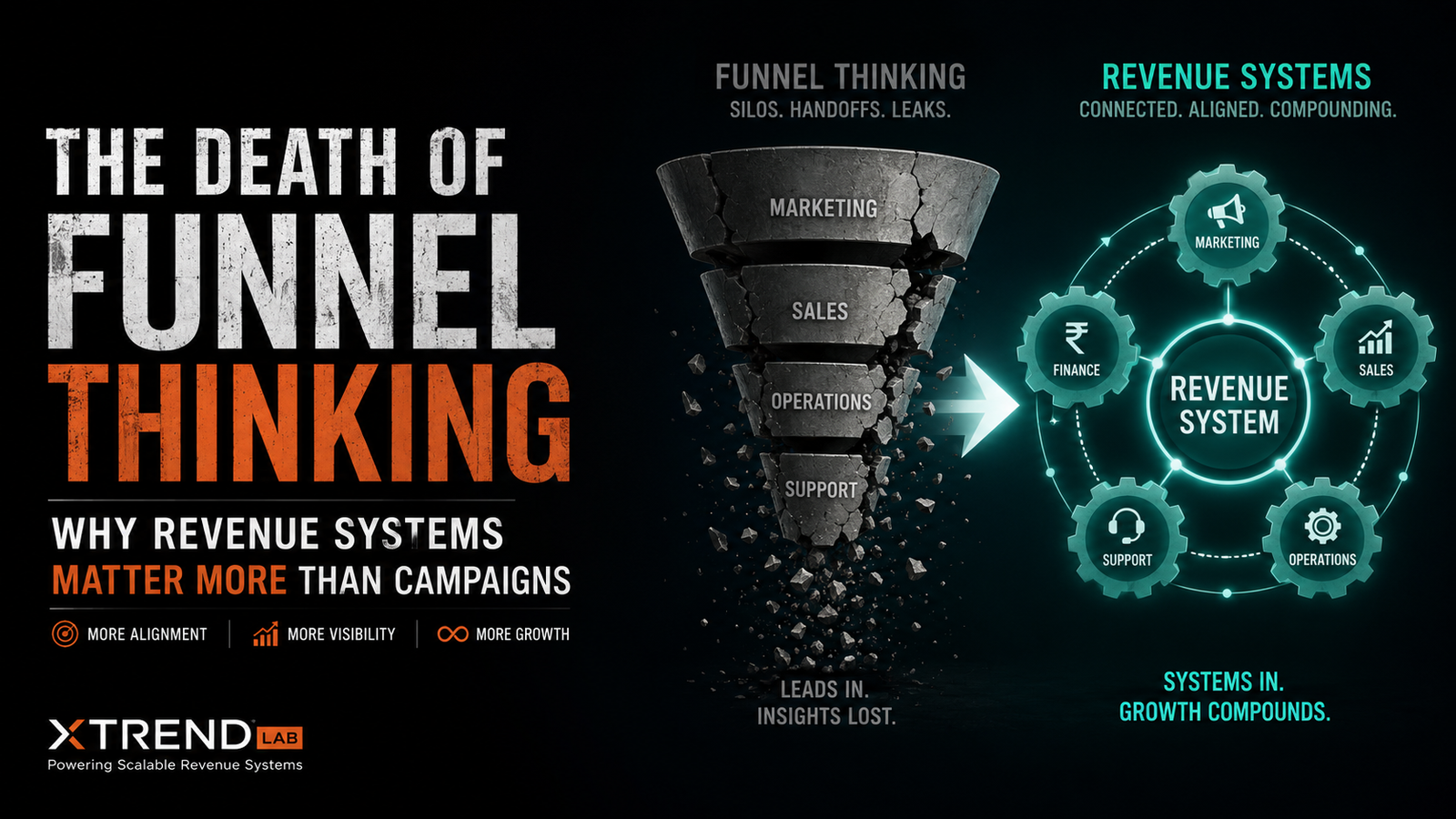
Most businesses are still obsessed with funnels. Top of funnel, middle of funnel, bottom of funnel. Marketing generates leads, sales closes deals, and operations delivers services. Everyone stays in their lane. And that’s exactly where problems begin.
Customers don’t experience funnels, they experience businesses. They don’t care which department owns what; they only care about outcomes. The funnel was designed for a simpler world. Today’s businesses are more complex: channels have multiplied, sales cycles are longer, and customer expectations are higher. Revenue no longer flows through departments. It flows through systems. And systems think very differently from funnels.
Funnels Were Built For Acquisition
Funnels are excellent at generating attention. They help answer questions like how many people visited, how many clicked, how many became leads, and how many purchased. This model works well for measuring acquisition, but growth isn’t only about acquisition.
Growth depends on customer experience, speed, follow-up, retention, cross-selling, support, and visibility. Funnels rarely account for these variables, because funnels stop where customers begin. Businesses cannot.
Departments Create Friction
Marketing celebrates leads. Sales celebrates revenue. Operations celebrates delivery. Finance celebrates cash flow. Each team optimizes its own objectives, and nobody optimizes the entire customer journey. This creates friction.
Marketing says they generated 500 leads. Sales says most of them were poor quality. Operations says customers expect things that were never promised. Finance says cash flow is unpredictable. Nobody is wrong, but nobody is aligned either. Funnels encourage handoffs. Systems encourage continuity. And continuity creates growth.
Funnels Break When Complexity Increases
Simple businesses survive with simple models, but complexity changes everything. More channels, more products, more customers, more employees, more software, more data; and eventually, information becomes fragmented. Marketing uses one platform, sales uses another, support uses a third, and finance relies on spreadsheets. Nobody sees the complete picture. The funnel begins leaking, and nobody knows why.
Customers Don’t See Departments
Customers don’t care about internal structures. They don’t think “I’m currently inside the marketing funnel.” They think “I need help.” To customers, everything feels like one experience.
If marketing promises something sales doesn’t understand, trust breaks. If sales closes a deal operations can’t deliver, trust breaks. If support responds slowly, trust breaks. Customers experience continuity; businesses often operate in silos. That’s why systems matter.
Campaigns Create Spikes
Businesses love campaigns. Campaigns feel exciting: traffic increases, leads rise, meetings happen, and revenue spikes. Then things return to normal. Campaigns are temporary; systems are permanent. Campaigns create bursts; systems create compounding.
Businesses that depend entirely on campaigns eventually become exhausted. Businesses built around systems compound over time, because systems improve continuously. Campaigns expire. Systems evolve.
Revenue Doesn’t Belong To Marketing
One of the biggest misconceptions in business is that revenue belongs to marketing. It doesn’t. Revenue belongs to everyone. Marketing creates awareness, sales creates trust, operations creates delivery, support creates retention, and finance creates sustainability. Revenue emerges from all of them working together.
Funnels divide responsibilities. Revenue systems align them. Alignment creates leverage.
Why Revenue Operations Changes Everything
Revenue Operations isn’t another department, it’s a framework. Its purpose is simple: create visibility, reduce friction, align teams, and improve predictability. Instead of separate goals, Revenue Operations focuses on shared outcomes.
Questions become: where are deals slowing down, which channels create profitable customers, why are customers leaving, which processes create delays, and how healthy is the pipeline. The objective shifts from activity to outcomes.
Data Fragmentation Is The Silent Killer
Most businesses already have data. The problem is fragmentation. Google Analytics, CRM, ad platforms, Excel sheets, invoices, support tools, and WhatsApp conversations; information exists everywhere, but intelligence exists nowhere. When systems don’t communicate, businesses operate blindly. Forecasting becomes unreliable, opportunities get lost, and customer experiences become inconsistent. Disconnected tools create disconnected decisions.
Speed Beats Complexity
Growth isn’t always about working harder. Often, it’s about removing friction. How quickly are leads contacted? How fast are proposals delivered? How many follow-ups happen? Where do customers disappear? How long do deals stay inactive? These variables matter more than impressions and followers, because speed compounds. Delays compound too. Operations determine velocity, and velocity determines growth.
Funnels Ignore Retention
Funnels focus on acquiring customers. Revenue systems focus on keeping them. Acquisition is expensive; retention compounds. Existing customers create repeat purchases, referrals, upsells, and better margins, yet many businesses spend all their energy attracting customers while neglecting those they already have. Funnels optimize entry; systems optimize relationships. Relationships create durability.
Revenue Systems Create Visibility
Visibility changes everything. Without it, managers react emotionally, forecasts become guesses, problems stay hidden, and teams blame each other. With visibility, bottlenecks become obvious, risks appear earlier, decisions improve, and growth becomes predictable. Visibility turns complexity into clarity, clarity creates confidence, and confidence creates momentum.
Every Business Eventually Becomes An Operations Business
At the beginning, growth comes from effort. Founders do everything, and speed compensates for inefficiency. But growth creates complexity, complexity creates friction, and friction demands systems.
Eventually, every business discovers the same truth: growth isn’t a marketing problem, it’s an operations problem. The companies that recognize this early build an advantage competitors struggle to replicate, because systems compound. Chaos compounds too.
The Future Belongs To Revenue Systems
Funnels aren’t disappearing completely, they still matter. But funnels alone are no longer enough. Businesses need something bigger: something that connects marketing, sales, operations, support, finance, data, and customers. That’s what revenue systems do. Campaigns create moments. Systems create momentum. And momentum compounds.
Frequently Asked Questions
What is the difference between a funnel and a revenue system?
Funnels primarily focus on customer acquisition. Revenue systems connect marketing, sales, operations, and retention to optimize the entire customer lifecycle.
Why do funnels break as businesses grow?
Growth increases complexity. More channels, tools, and departments create silos that traditional funnel thinking cannot manage effectively.
What is Revenue Operations?
Revenue Operations aligns teams, processes, and technology to improve visibility, reduce friction, and create predictable growth.
Why are systems more important than campaigns?
Campaigns generate short-term spikes. Systems improve continuously and create long-term compounding growth.
Do startups need Revenue Operations?
Yes. Startups benefit from operational alignment early because complexity increases rapidly as businesses scale.
Build Revenue Systems, Not Just Campaigns
Campaigns create attention. Systems create growth. At XTrend Lab, we help businesses align marketing, sales, operations, and data into revenue systems designed for long-term scale, because growth doesn’t happen inside departments. It happens across systems.
Start a conversation and build a revenue engine that compounds.
XTrend Lab Strategy Team
We are a collective of data engineers, strategists, and digital architects. We write about what works in the real world, based on our experience building systems for growing enterprises.