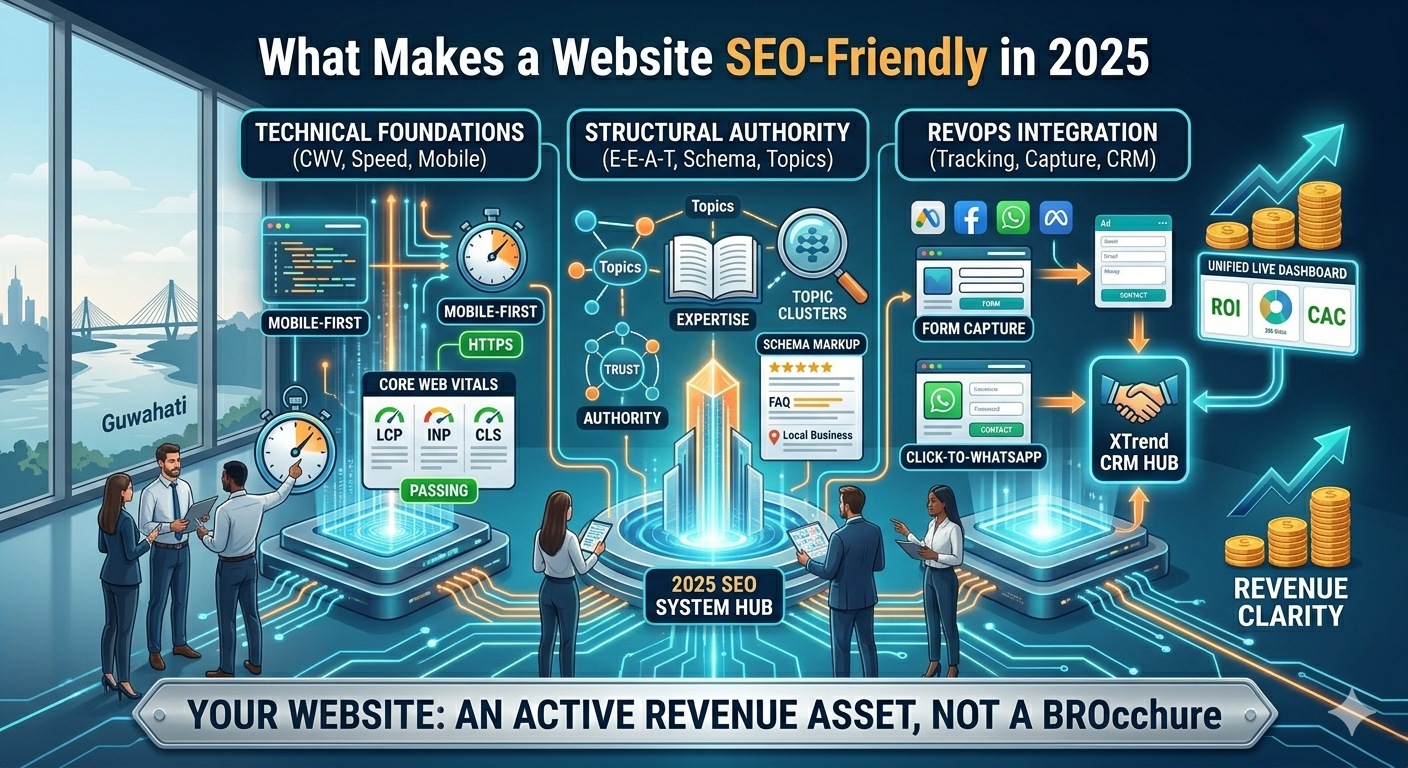
By 2025, the definition of an “SEO-friendly website” has shifted fundamentally. It’s no longer just about optimizing technical elements to get clicks. It’s about creating an integrated, high-performance system that converts traffic into revenue.
In the era of AI-driven search and answer engines (AEO), Google isn’t just looking for relevant keywords; it’s looking for websites that deliver superior user experience, proven authoritativeness, and measurable business outcomes.
In 2025, an SEO-friendly website is a fast, secure, and accessible system built on a foundations of Core Web Vitals. It leverages technical SEO and structured data to satisfy both human intent and AI scrapers. Crucially, it must integrate with a RevOps system, ensuring visitor behavior is tracked and converted into actionable data.
1. Technical Performance: The 2025 Baseline
Technical execution is the bedrock of visibility in 2025. If your site is not healthy, Google will not prioritize it, regardless of your content quality.
Core Web Vitals (CWV) are Non-Negotiable
CWV are Google’s real-world metrics for speed, responsiveness, and visual stability. An SEO-friendly site must excel at all three:
- Loading Speed (LCP): Your main content must load within 2.5 seconds, specifically on mobile.
- Interactivity (INP): The time from a user’s first interaction (click/tap) to the site’s response must be almost instant. Note: INP officially replaced FID as a core metric in 2024.
- Visual Stability (CLS): Content must not shift unexpectedly, preventing frustrating “wrong click” errors.
Security, Mobile-First, and Accessibility
- HTTPS: Absolute standard. A secure connection is essential for user trust and ranking.
- Mobile-First Design: Google indexes your mobile site first. An SEO-friendly site must look and function flawlessly on smartphone screens, with simple navigation and readable font sizes.
- Accessibility (WCAG): Sites that are accessible to all users (including those with disabilities) get ranked higher. Alt text for images, high-contrast text, and keyboard navigation are not optional.
2. Structural Authority: Content and E-E-A-T
Your content needs to prove Experience, Expertise, Authoritativeness, and Trustworthiness (E-E-A-T), especially to AI algorithms deciding which site to recommend as the source of a “direct answer.”
Structured Data and Schema Markup
In 2025, you must “wrap” your content in technical language that AI can understand.
- An SEO-friendly site uses Schema Markup (Product, FAQ, Local Business, Article) to provide context.
- This markup allows Google to generate “rich results”—those snippets, star ratings, and prices that make your listing dominate the search results page.
The Connected Topic Architecture
Google has moved beyond keywords to semantic entities and “topics.” An SEO-friendly site structure avoids scattered pages:
- Use Topic Clusters: Group content around central “pillar pages,” proving deep, comprehensive knowledge in your specific niche.
- For regional businesses, include specialized local content (Guwahati, Assam context) to prove authority within your geographical service area.
3. Convergent SEO: The Website-RevOps Integration
The “missing layer” in traditional SEO is what happens after the click. In 2025, an SEO-friendly website is designed for lead capture, tracking, and attribution.
Conversion-Focused Architecture
A site that gets traffic but zero conversions is not friendly to your business.
- Integrated Lead Capture: Forms, click-to-WhatsApp, and booking calendars must be technically integrated into your core website system.
- Tracking Layer: The site must contain custom code (like GTM or proprietary XTrend tracking) that captures visitor source data (UTMs) and behavioral heatmaps from the very first click.
Direct Line to the CRM
The defining characteristic of a modern SEO site is its connection to the rest of your business ecosystem.
- No “Manual Data Silos”: Lead data must automatically flow into your CRM, allowing you to automate follow-ups and track the customer journey from search to closed deal.
- AEO Describability: The way your services are structured on-page should describe not just what you do, but how you deliver value, providing direct answers that LLMs can surface for users.
FAQs
What makes a website SEO-friendly?
An SEO-friendly website satisfies both search engines and users by excelling in three core areas: 1) Technical health (speed, CWV, security, mobile-first design), 2) Content authority (E-E-A-T, topical clusters, schema), and 3) Conversion design (lead capture, RevOps integration for lead tracking).
How is SEO different in 2025?
In 2025, SEO has expanded to Answer Engine Optimization (AEO). While keywords are still necessary, sites are now prioritized for speed, structured schema markup that AI can read, andproven trustworthiness, rather than just link volume or keyword density.
Is technical SEO enough for good rankings?
No. Technical SEO ensures your site can be indexed and ranked by Google, but you still need superior, human-focused content to satisfy the “Helpful Content” algorithms and convert visitors into customers.
What is Conversion-Focused SEO?
It is the integration of traditional SEO practices with lead conversion optimization. It focuses on driving high-intent traffic to pages that are designed technically and visually to capture that traffic as leads and flow them into a CRM system.
Technical Audit: Is Your Website Friendly in 2025?
Most businesses are still trying to rank with a 2018 playbook. A modern website is an active asset, not a brochure.
At XTrend Lab, we specialize in merging technical SEO with Revenue Operations. We build the systems that bridge the gap between traffic, tracking, and closed deals.
Book a free 30-minute audit today. We’ll perform a full health check on your site’s Core Web Vitals, schema implementation, and lead tracking layer.
LinkedIn Caption
Google’s playbook for 2025 isn’t about keywords. It’s about systems. 🚀
In 2025, an “SEO-friendly” website must satisfy two demanding audiences: the human user and the AI-driven Answer Engine (AEO).
A technically friendly site must deliver on three fronts: 1️⃣ Technical Speed & Accessibility: Core Web Vitals are now ranking requirements, not suggestions. If your site doesn’t load instantly, your ranking is dead. 2️⃣ Semantic Topical Authority: You must prove E-E-A-T to AI algorithms that decide which answers to surface in rich snippets and voice search. 3️⃣ RevOps Integration: Traffic is useless if you don’t know where it came from. A friendly site automatically captures lead source data and behavior, flowing it into a unified CRM system.
It’s time to move beyond vanity metrics like “impressions.” If your website is technically friendly but disconnected from your revenue, you don’t have an asset; you have a brochure.
👉 Read our guide on what makes a website SEO-friendly in 2025: [Link to Blog] 👉 Ready to audit your system? Book your free 30-min session: xtrendlab.com/get-in-touch/
#TechnicalSEO #AEO #CoreWebVitals #RevOps #LeadTracking #BusinessGrowth #GuwahatiSEO #XTrendLab #DigitalPerformance #MarketingStrategy
XTrend Lab Strategy Team
We are a collective of data engineers, strategists, and digital architects. We write about what works in the real world, based on our experience building systems for growing enterprises.